



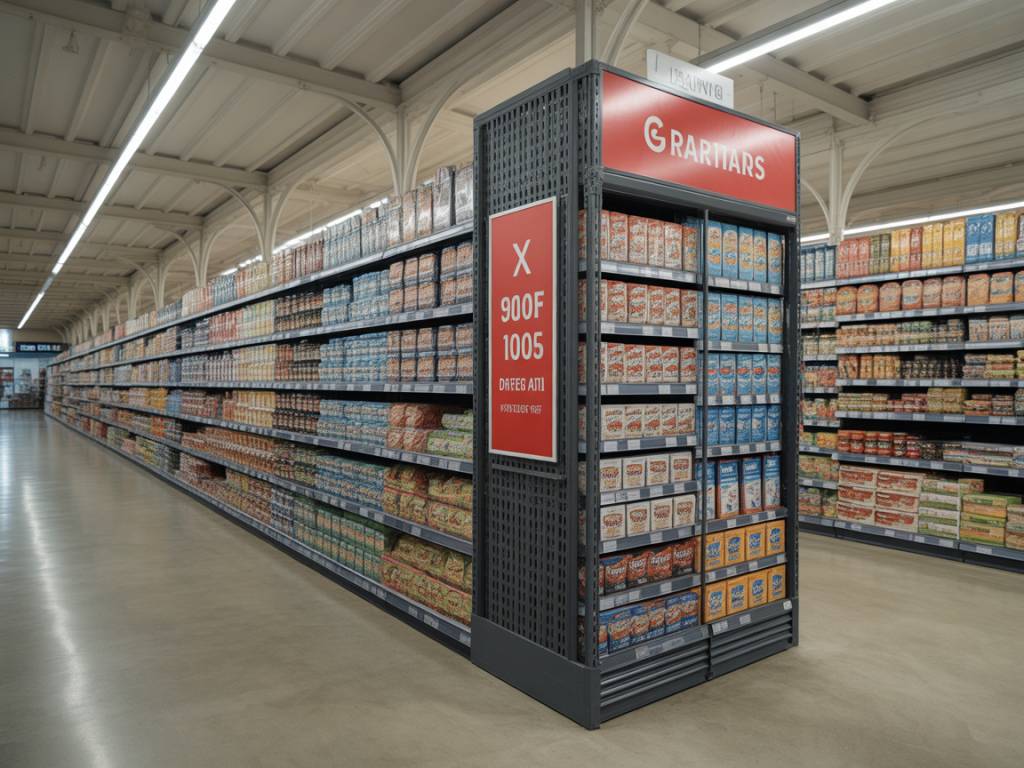

Walk through any major UK retailer and you’ll spot them immediately — branded, freestanding, stocked and ready. Free standing display units (FSDUs) have become a fixture of modern retail environments, yet their strategic value to the supply chain is rarely discussed beyond the marketing department. That’s a significant oversight. When deployed intelligently, FSDUs don’t just sell products — they fundamentally reshape how goods flow from manufacturer to shopfloor.
How Free Standing Display Units Enhance Retail Supply Chains from the Ground Up
The traditional retail supply chain involves multiple touchpoints: warehousing, pick-and-pack, delivery to store, back-room storage, and manual shelf-stocking. Each stage adds time, cost, and the risk of damage or error. FSDUs compress many of these steps into a single, retail-ready unit that arrives pre-stocked, pre-branded, and immediately deployable.
This shift has real operational consequences:
- Fewer handling stages: Products travel inside the FSDU from factory to retail floor, reducing the number of times they are touched — and the number of opportunities for damage or mispicking.
- Faster floor placement: Store staff simply position the unit rather than unboxing, sorting, and restocking individual items. This frees up labour for customer-facing tasks.
- Simplified SKU management: An entire FSDU can be treated as a single stock-keeping unit, making inventory tracking and replenishment ordering significantly more straightforward.
For logistics providers like Terra Logistics, the ability to deliver a finished display unit directly to a retail location — bypassing the distribution centre entirely — is one of the most tangible efficiency gains FSDUs bring to the table.
Standardisation and Transport Planning Benefits
Predictability is one of the most undervalued assets in supply chain management. Pre-packed FSDUs offer defined dimensions, consistent weights, and uniform structures that integrate cleanly into transport management software. This makes vehicle load planning and route optimisation considerably more precise.
Because FSDUs are typically produced around promotional campaigns with fixed launch dates, distribution timelines can be coordinated with far greater accuracy than standard stock replenishment. The result is tighter synchronisation between marketing and logistics — a challenge that has historically caused friction between the two functions.
For retailers, standardised FSDU dimensions also allow floor space to be pre-allocated before delivery, eliminating the back-room chaos that often accompanies large promotional drops. Planograms can be updated in advance, and store teams know exactly where each unit is going before the lorry arrives.
Direct-to-Store Delivery: Cutting Out the Middle Step
One of the most powerful applications of FSDUs in the retail supply chain is enabling direct-to-store delivery (DSD) models. Rather than routing product through a retailer’s regional distribution centre, suppliers can ship fully assembled display units straight to individual store locations.
The advantages are measurable:
- Reduced lead times: Removing a distribution hub from the journey can cut time-to-floor by several days during peak campaigns.
- Lower warehousing costs: Neither the supplier nor the retailer needs to hold the stock in a conventional warehouse environment.
- Improved campaign timing: Products hit the floor precisely when the promotional window opens, not days later due to DC backlogs.
In practice, a UK soft drink brand working with Terra Logistics on a summer flavour launch used direct-to-store FSDU delivery across a test region. The outcome included a 22% faster time-to-market and a 17% reduction in on-site handling time — with no disruption to the retailers’ existing shelf layouts.
Smart FSDUs: Data Collection on the Shopfloor
The next evolution of free standing display units moves them from passive fixtures to active data sources. Through RFID tags, QR codes, and smart labels, modern FSDUs can capture and transmit real-time performance data throughout a campaign.
The intelligence gathered includes:
- Sell-through velocity by store location
- Time elapsed since last restocking event
- Regional performance comparisons across multiple retail sites
- Early signals of over- or under-performance that trigger mid-campaign adjustments
This data feeds directly into demand forecasting models, allowing supply chain teams to reallocate inventory dynamically rather than waiting for end-of-campaign reporting. In the beverage brand example above, QR code tracking data allowed the company to concentrate rollout investment on the top-performing 40% of stores — a decision made mid-campaign, not after it.
When FSDUs are integrated into a broader supply chain visibility platform, they become a shopfloor sensing layer that most traditional retail deployments simply cannot replicate.
Peak Season Agility Without Planogram Disruption
Retail space is finite and fiercely contested. During peak trading periods — Black Friday, Easter, summer beverage season — brands compete for prime floor positions that can make or break a product’s performance. FSDUs offer a way to claim that space without requiring a full planogram reset.
A pre-stocked display unit can be rolled into position at the end of an aisle or near a checkout in minutes. It captures high-footfall locations without displacing permanent shelf arrangements, making it far easier for retail buyers to say yes to a promotional placement. Once the campaign ends, the unit is removed and recycled, leaving no lasting impact on store layout.
For logistics teams, this plug-and-play model translates into simpler returns management and a cleaner end-of-campaign process — particularly when compared to the complexities of recovering unsold promotional stock from standard shelving.
Sustainability Credentials Worth Noting
FSDUs made from corrugated cardboard are widely perceived as wasteful. In reality, when designed and deployed with sustainability in mind, they can support a leaner, greener supply chain.
- Material recyclability: FSC-certified corrugated board with vegetable-based inks is fully recyclable at end of use, and many retailers now have dedicated collection processes for promotional units.
- Tighter demand forecasting: Campaign-specific FSDUs are stocked to a predetermined quantity, reducing the overproduction and excess inventory that plagues standard promotional activity.
- Consolidation opportunities: Their stackable, uniform structure allows multiple units to be transported together efficiently, reducing the number of vehicle movements required per campaign.
Sustainability in logistics rarely comes from a single dramatic intervention. More often, it accumulates through smarter upstream design decisions — and FSDUs are a good example of packaging that, when handled correctly, makes downstream operations lighter and less wasteful.
Best Practices for Integrating FSDUs into Your Supply Chain Strategy
Getting the most from free standing display units requires treating them as supply chain assets from the earliest design stage, not as an afterthought once the marketing brief is signed off.
- Involve logistics early: Unit dimensions, weight, and pallet configuration should be defined in collaboration with your logistics provider before production begins. Small design choices have outsized effects on freight costs and handling efficiency.
- Build in data capture: Even a simple QR code adds measurable value. Define the KPIs you want to track before the unit goes to print.
- Standardise across SKUs and markets: Where multiple product variants or geographies are involved, a shared structural template reduces tooling costs and simplifies transport planning.
- Respect weight limits: Keep individual units light enough for single-person handling. Exceeding freight classification thresholds can increase shipping costs significantly and create health and safety issues in-store.
- Plan the end-of-life process: Define how units will be collected, broken down, or recycled before deployment, not after the campaign ends.
The Broader Case for FSDUs in Modern Retail Logistics
Free standing display units sit at an interesting intersection: they are simultaneously a marketing tool, a logistics asset, and increasingly a data collection device. The brands and logistics partners who recognise all three dimensions are the ones extracting the most value from every unit deployed.
For UK retailers and FMCG suppliers operating in a market defined by tight margins, compressed timelines, and rising consumer expectations, FSDUs offer a practical mechanism to move faster, spend less on handling, and gather better intelligence from the shopfloor. That is not a minor operational tweak — it is a meaningful competitive advantage hiding in plain sight at the end of the aisle.