



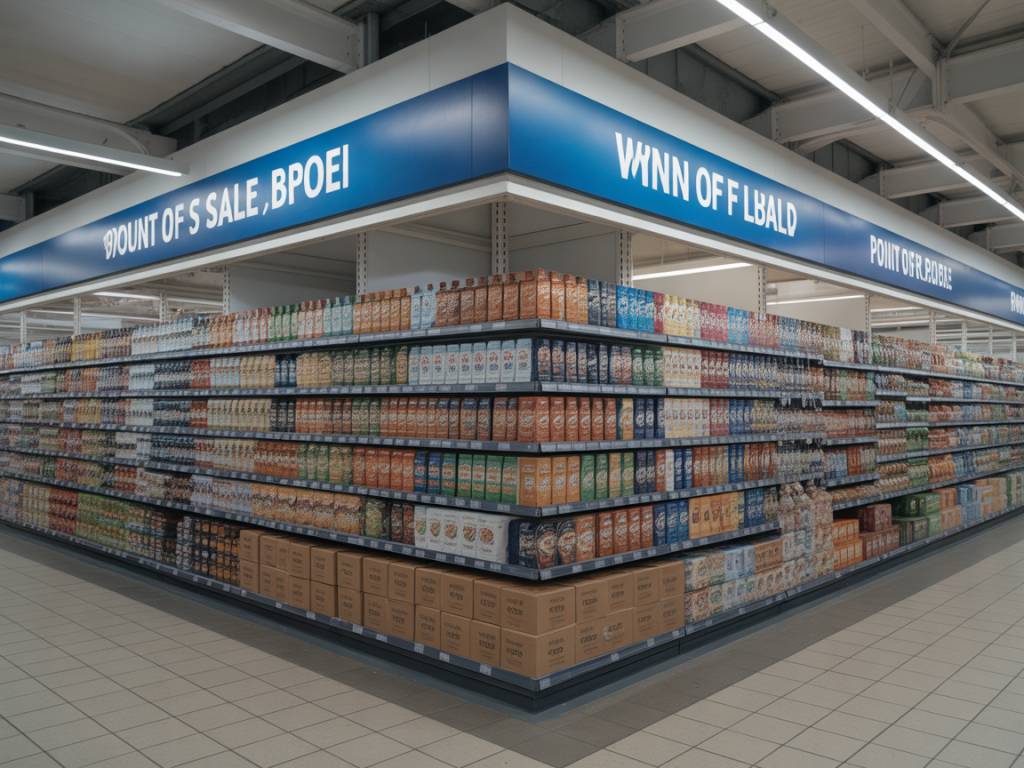

Walk into any supermarket, electronics retailer, or airport duty-free, and you’re immediately surrounded by product towers, end caps, floor-standing units, and impulse-buy bins — all carefully positioned to catch your eye at the exact moment you’re most likely to spend. These are point of sale displays, and while shoppers interact with them in seconds, the logistics operation behind each one can span weeks of planning, coordination, and precision execution.
So, what is point of sale display and why it matters in retail logistics? The answer goes far beyond cardboard and clever design. POS displays sit at the crossroads of marketing, supply chain management, and in-store execution — and when they’re done right, they drive measurable sales uplifts and sharper operational efficiency.
What is Point of Sale Display? A Clear Definition
A point of sale display is any branded, standalone promotional unit placed near or at the point of purchase — checkout zones, aisle ends, store entrances, or impulse-buy corners. Their purpose is to increase product visibility, encourage unplanned purchases, and support time-sensitive promotions.
Common formats include:
- Floor-standing display units (FSDUs): Tall, freestanding structures placed on the shop floor, often used for new product launches or seasonal ranges.
- Counter display units (CDUs): Compact units designed to sit on counters or near tills, ideal for small, high-margin impulse products.
- End caps: Displays positioned at the end of a retail aisle, commanding high footfall and visibility.
- Pallet displays: Full pallet-sized units delivered pre-stocked, common in grocery and DIY retail for volume promotions.
- Dump bins: Open-top containers for loose, low-cost items — think batteries, seasonal confectionery, or accessories.
Each format carries its own logistical requirements in terms of assembly, transport, in-store placement, and post-campaign removal — which is precisely why retail logistics teams must be involved from the very start of any POS campaign.
What is Point of Sale Display and Why It Matters in Retail Logistics
POS displays are not simply a marketing tool — they are an active component of the retail supply chain. Every display that reaches a shop floor has passed through warehousing, co-packing, transport planning, distribution, and in-store execution. Miss any one of these steps and the campaign loses momentum, costs escalate, or worse, the display never makes it to the floor in time.
Here is why POS displays carry genuine weight in logistics planning:
- Speed-to-shelf is critical: Promotions are time-bound. A display that arrives two days late to a Valentine’s Day campaign or a bank holiday push can cost thousands in missed sales. Logistics teams must work backwards from in-store deadline to manufacturing go-ahead — often with very tight windows.
- Custom packaging and SKU complexity: Unlike standard stock, POS displays frequently involve bespoke bundling, branded outer packaging, and multi-SKU kits. This adds layers of co-packing coordination that standard warehouse flows are not always built to handle.
- Store-by-store distribution precision: Not every location receives the same allocation. Distribution plans must account for store format, floor space, sales velocity, and demographic fit — meaning routing and quantities vary significantly across a network.
- Reverse logistics planning: What happens after the campaign ends? Displays need to be collected, dismantled, and either recycled, refurbished, or redistributed. Failing to plan this in advance creates cost and waste downstream.
- Real-time data integration: Modern POS units increasingly incorporate RFID tags or IoT sensors that feed stock-level and interaction data back into supply chain systems — tightening the feedback loop between in-store performance and replenishment decisions.
The Full Lifecycle of a Point of Sale Display
Understanding the journey a POS display takes — from brief to bin — reveals just how many logistics touchpoints are involved.
Design and prototyping
Marketing and packaging engineers collaborate to create a display that is both on-brand and physically shippable. Structural integrity matters: a display loaded with 80 chocolate bars needs to survive palletised transit without collapsing on the shop floor.
Manufacturing and supplier coordination
Display units are typically produced by specialist third-party manufacturers. Lead times here — often four to eight weeks — set the entire downstream logistics schedule. Delays at this stage compress every subsequent step.
Co-packing and kitting
Products are loaded into display units either at a centralised distribution centre or via a dedicated co-packer. This stage demands precision: wrong quantities, incorrect labels, or mismatched SKUs result in in-store errors that damage both the campaign and retailer relationships.
Transport and delivery
Whether routed direct-to-store or through regional distribution hubs, transport planning must account for the bulk and fragility of pre-populated displays, store-specific delivery windows, and the need for coordinated drop-off across potentially hundreds of locations on the same day.
In-store execution and compliance
Some displays arrive flat-packed for store staff to assemble; others are delivered pre-built. Field teams or merchandising agencies are often deployed to ensure correct placement, particularly for high-value campaigns where compliance photography and reporting are required.
Post-campaign retrieval and disposal
Reverse logistics for POS displays is often overlooked until it becomes an operational headache. Pre-booking collection routes, defining recyclability standards, and planning for leftover stock redistribution should be embedded in the original campaign logistics plan.
A Real-World Example: Seasonal Confectionery at Scale
Consider a European snack brand launching a limited-edition product range across 1,200 UK retail locations ahead of Valentine’s Day. Each store was to receive a heart-shaped FSDU pre-loaded with 120 units.
The logistics plan involved:
- A three-week execution window from manufacturing sign-off to in-store delivery.
- Co-packing at a single central facility, requiring synchronised delivery of display units and product stock within a 48-hour window.
- Transport routing that accounted for February weather risks, varied store delivery windows, and restricted access at city-centre locations.
- Pre-booked reverse logistics for display collection and recycling at campaign end.
The outcome: a 37% uplift in off-shelf sales over the three-week promotional window, with a 91% on-time delivery rate across all locations. The campaign succeeded not because the display was eye-catching — though it was — but because the logistics behind it were airtight.
Technology Driving POS Logistics Forward
The intersection of retail technology and supply chain innovation is transforming how POS displays are planned, deployed, and measured.
- Modular display systems: Interchangeable components allow retailers to reconfigure units between campaigns, reducing waste, storage costs, and manufacturing lead times.
- IoT-enabled displays: Embedded sensors track stock levels and customer interactions in near-real time, feeding data directly into warehouse management and replenishment systems.
- Robotics in co-packing: Automated kitting lines are increasingly used for high-volume POS campaigns, improving speed, consistency, and accuracy across large product runs.
- Dynamic routing platforms: Modern transport management software allows route planners to adjust delivery schedules in real time based on store readiness, traffic conditions, or last-minute changes to promotional timings.
Best Practices for Smoother POS Campaign Execution
Whether you manage a national retail network or support brands with their logistics needs, these principles consistently separate successful POS campaigns from costly ones:
- Involve logistics at the briefing stage — not after creative has been signed off. Early visibility of timelines, formats, and volumes allows for realistic planning.
- Use store-level data to drive allocation decisions. Sales velocity, floor space, and demographic data should inform quantities, not gut feel.
- Build contingency into every timeline — supplier delays, weather disruptions, and last-minute retailer changes are predictable in their unpredictability.
- Integrate co-packing into your WMS to maintain stock visibility across the display assembly process and reduce the risk of fulfilment errors.
- Plan reverse logistics from day one. Knowing how displays will be collected, recycled, or repurposed before the campaign launches saves significant cost and complexity at the back end.
Why POS Display is a Strategic Asset, Not an Afterthought
In a retail environment where margins are tight and consumer attention is contested at every aisle, point of sale displays remain one of the most effective tools for driving incremental revenue. But their commercial impact is only as strong as the logistics infrastructure supporting them.
From co-packing and transport to in-store compliance and reverse collection, every stage of the POS display lifecycle demands careful coordination. Retailers and logistics providers who treat POS execution as a strategic priority — rather than a last-minute delivery job — consistently outperform those who don’t.
At Terra Logistics, we work with brands and retailers to build the end-to-end supply chain capability that turns great promotional ideas into flawless in-store reality. If your next campaign deserves better logistics behind it, get in touch with our team.